
Introduction to Micro-Management of Self
Understanding self micro-management in leadership is key to gaining clarity in your behaviour, strengthening self-awareness, and moving confidently into self-stewardship.
Self micro-management in leadership is often invisible, yet it shapes how many professionals think, respond and show up at work.
It does not always look like stress or overwhelm on the surface. In fact, it often looks like thoughtfulness, preparation and emotional intelligence.
But underneath, there can be something else at play.
Micro-management of self.
What is micro-management of self?
Micro-management of self is the practice of excessively controlling, monitoring and adjusting our own thoughts, behaviours and responses, often in an attempt to get things right.
It can show up as:
- Replaying conversations in your head
- Over preparing what to say
- Seeking multiple perspectives but still feeling unclear
- Managing how others might feel, respond or interpret you
At its core, it is not about capability. It is about control.
And often, it is driven by a desire to be heard, understood and respected.
In one of my own reflections, I noticed this clearly. I had asked five different colleagues how they thought I should respond to a situation and I was still unsure. I did not know exactly what was bothering me, nor what I wanted the other person to hear. All I knew was that I was not comfortable.
That is the internal tension many of us recognise. The energy drain that comes not from the situation itself, but from how much we are trying to manage ourselves within it.
How to identify it
Micro-management of self is not always obvious. It is often hidden inside behaviours we value.
Here are a few signals worth noticing:
- You feel mentally tired after thinking about the same issue repeatedly
- You seek clarity but remain in a loop of uncertainty
- You are managing tone, delivery and perception more than the message itself
- You feel responsible for how others receive what you say
What is worth tracking is not every thought, but the patterns:
- Energy: what drains you versus what feels clear
- Repetition: where you revisit the same issue without movement
- Ownership: what is yours to hold and what is not
Self stewardship versus micro-management
There is an important distinction to make.
Self stewardship is a strength. Micro-management of self is a drain.
Self stewardship looks like:
- Being intentional about how you show up
- Reflecting to learn and improve
- Communicating with clarity and awareness
- Trusting your judgement and refining over time
Micro-management of self looks like:
- Over editing your thoughts and words
- Second guessing decisions repeatedly
- Managing other people’s reactions
- Focusing on getting everything right in the moment
The difference is subtle but important.
One is grounded in self-awareness. The other is driven by control.
A framework for self-awareness and action
To move out of micro-management and into self-stewardship, a simple reflective framework can help:
Notice
Pause and ask yourself what is happening. Am I managing the situation or managing myself? Is there a piece in here, that is mirroring an understanding of myself?
Clarify
What is bothering me here? What do I want to communicate or achieve?
Own
What is mine in this moment? What belongs to the other person?
Decide
What is one clear and proportionate action I can take?
Release
Let go of the need to control everything else. Allow the outcome to unfold.
Reflect
Afterwards, reflect on what worked and what you would do differently, without judgement.
This is not about getting it perfect. It is about reducing unnecessary effort and increasing clarity.
A closing reflection
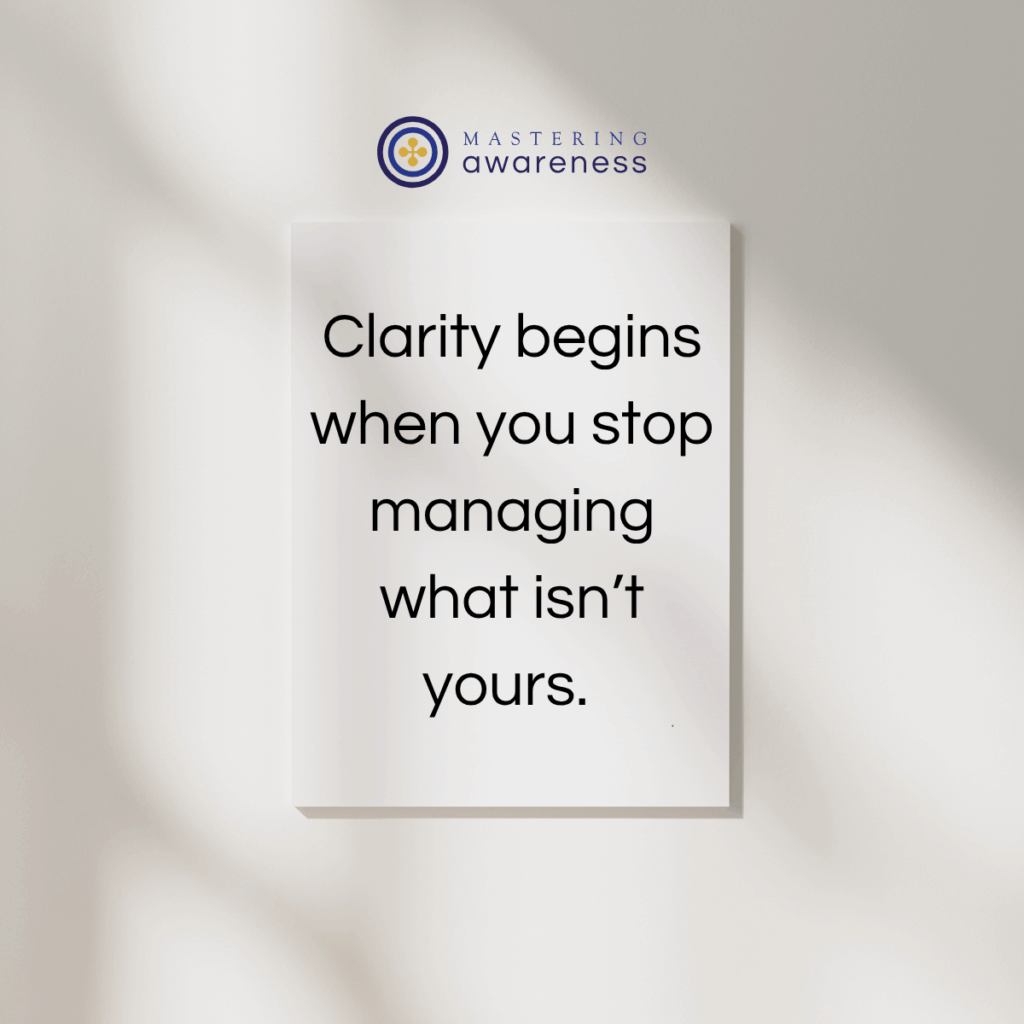
Not every interpersonal challenge is yours to fix.
Sometimes, the work is not to say more, soften more or manage more.
Sometimes, the work is to be clear about what is yours, and to trust that clarity is enough.
Micro-management of self can feel productive, but over time it becomes exhausting.
Self-stewardship, on the other hand, creates space. It allows you to show up with intention, respond with clarity and move forward without carrying what does not belong to you.
Self-stewardship starts with self-awareness. And self-awareness requires a deeper understanding of who you are, what you value and what truly matters to you across different areas of your life.
It asks you to let go of expectations shaped by early experiences and step forward with courage, on terms that genuinely reflect your own understanding of what your life and experiences mean to you.
And often, that is where your real influence lies.
And that is a form of self-leadership.
A closing reflection
If you are curious to explore this further, you are welcome to explore how this space can support you.
We’d love to hear your perspective. Have you experienced some of these challenges, or found ways to overcome them? Drop us an email to share your story, or connect with us on social media and join the conversation.
Creating spaces where self-leadership is intentional, without the pressure of getting it right all the time.